
“How to find hidden gems in Greece that aren’t touristy (2026 guide)”
- Levente Tóth
- Apr 10
- 14 min read

Updated: Apr 16
Everyone says they want to experience the “real Greece”:
Quiet beaches. Small tavernas. Hidden viewpoints. Places that don’t feel like they were built for Instagram.
And yet, most people end up in the exact same crowded spots.
Not because they want to, but because finding truly non-touristy places in Greece is much harder than it seems.
In this article, I’ll break down the reality behind it, share practical tips on how to actually find these places, and what to expect from the process.

Why “non-touristy Greece” is so hard to find
At first glance, it feels simple:
You open Google Maps.
You watch a few YouTube videos.
You read a couple of blog posts.
You build your own itinerary.
Done, right?
Not really.
Because what those sources don’t show you is what actually happens on the ground, when you are already there. Or just how to get there.

The reality of planning your own trip
Planning a trip to Greece on your own doesn’t just take time before the trip. It keeps taking time during the trip.
1. You spend hours researching but still miss key details
You find beautiful places online, but:
no exact location
no clear parking information
no realistic access details
no idea what it’s actually like in peak season
So you go anyway, hoping it works out.
Sometimes it does. Sometimes it really doesn’t.

2. You waste time on unnecessary driving
On the map, everything looks close but in reality:
roads are slower than expected
parking is chaotic
some places are not worth the detour
You end up driving more than you should, and enjoying less than you could.
3. You don’t know what’s worth your time
This is the biggest one.
Some places are:
absolutely worth it
worth it only at a specific time of day
or honestly… not worth it at all
But without local knowledge, you can’t tell the difference in advance.
So you:
leave great places too early
stay too long in average ones
miss the best moments entirely

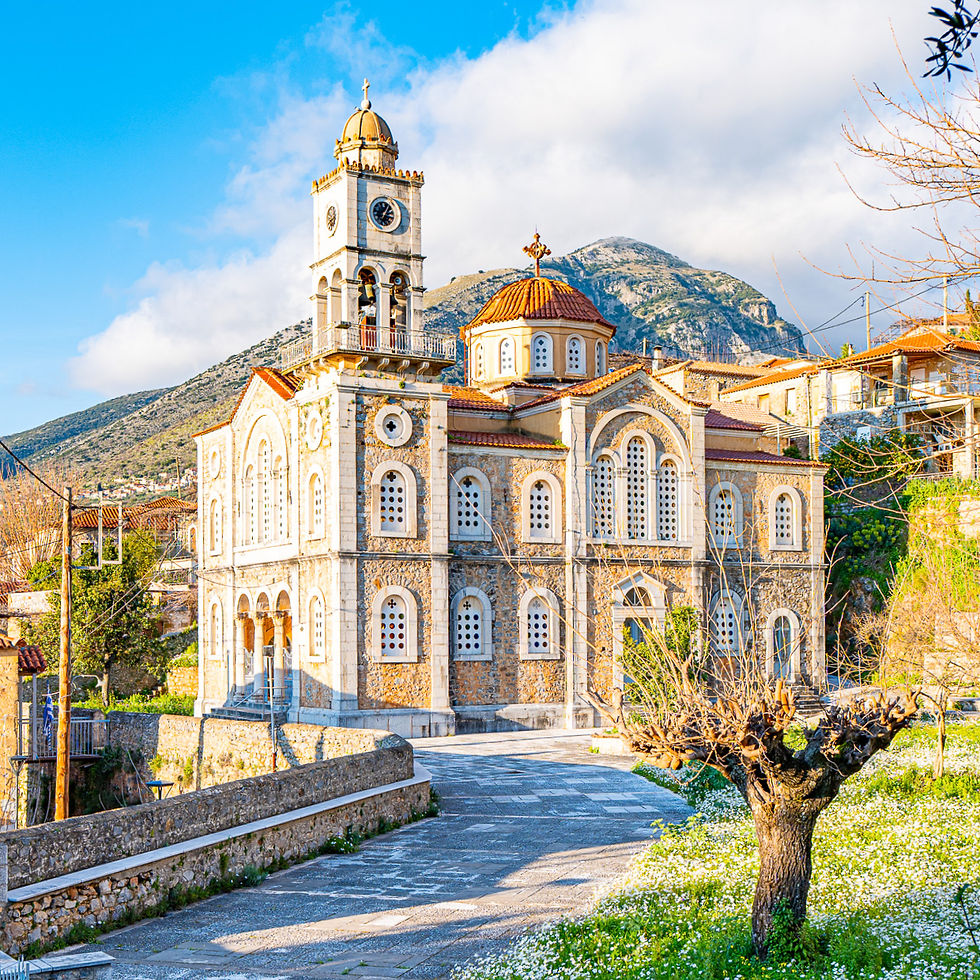
Small church with stunning views over the Viros Gorge, with the stunning Taygetos mountains in the background
4. Logistics quietly eat your day
Parking alone can ruin the experience.
In peak season:
finding a spot can take 30–40 minutes
sometimes it feels impossible
Public transport?
unclear schedules
hard-to-find stops
limited flexibility
And instead of enjoying Greece, you’re solving problems.
5. You don’t want to plan while you’re on vacation
After a full day:
you’re tired
you want to relax
not research the next day’s logistics
But if you don’t plan, you lose time again the next day.

The research process explained - preparation matters
In the sections below, I break down the process in detail with practical, step-by-step tips on how to get started. The focus here is Greece, but the same approach works in a very similar way for most other destinations as well.
Finding inspiration from YouTube videos
Search specific YouTube videos about the location you want to visit. Most of them are optimized for clicks and watch time, so they rarely reveal precise details such as exact coordinates, how to access the spot, or even how long it’s worth spending there. That said, they are still useful. Watch them, note down the places that seem promising, and then do deeper research on those specific spots

Travel blogs and articles: useful, but often limited
There are also travel articles and blog posts, but these come with even more limitations. In addition to still missing precise on-the-ground instructions, many of them are now heavily AI-generated and often recycle each other. This means not only are key places frequently left out, but in some cases the information itself can be incorrect, sometimes even placing a location in a completely different country. Reliable travel websites and established publications are generally safer, but it’s not always easy to verify which source you can trust, since low-quality AI content can look just as polished as credible writing.
Using Instagram and TikTok for discovery
Instagram and TikTok can also be useful by searching the name of a destination or region. You can often find incredible spots this way, but the same issue applies even more strongly: it is often difficult to figure out the exact location afterwards. Still, these platforms are great for discovery.
Verifying locations with reverse image search
The most effective method is to verify everything yourself, regardless of the source. One of the simplest ways is reverse image search. If you find a place you like but don’t know where it is, take a screenshot and run a Google image search or use Google Lens (also integrated into Google Photos).
This often reveals the location, although not always reliably. Images are frequently reused across multiple articles without proper attribution or accurate location data. So you will find the same image embedded in blogposts, Pinterest posts, and stock photo websites, but still missing the key info: where.

Asking for local knowledge (Facebook & Reddit)
A very effective method is asking for human input. Joining Facebook groups dedicated to a specific region or country can be extremely useful. You can upload an image and ask for help identifying the location.
There are English-language groups as well as local-language communities. Travel-focused groups tend to be the most helpful. Reddit works in a similar way: almost every region has its own subreddit. You can post in English, but if you want better results, translating your question into the local language (even using AI tools) can increase your chances of getting an answer.

Deep diving into Google Maps
Another strong approach is a deep, almost methodical exploration of Google Maps — and the easiest way to explain this is through a concrete example: finding a beach.
Start by switching to satellite view and scanning the coastline. Move slowly along the shore and look for areas where the water turns light blue or turquoise. This usually indicates shallow, clear water — often a good sign. At this stage, you’re not looking for names or famous spots, just visually interesting locations. Start by switching to satellite view and scanning the coastline. Move slowly along the shore and look for areas where the water turns light blue or turquoise. This usually indicates shallow, clear water — often a good sign. At this stage, you’re not looking for names or famous spots, just visually interesting locations.
Once you find something promising, zoom in and take a closer look at the surroundings. Then switch to Street View or check user-uploaded 360° photos by dragging the little figure onto the map (or tapping the blue dots on mobile). This helps you understand what the place actually looks like in real life, not just from above.
After that, it is essential to locate access points. If you are arriving by car, look for nearby parking areas or places where stopping a car is possible. Satellite view is often more reliable than labels, as many informal parking spots are not marked. You can simply look for parked cars on the satellite view. Street View can then help you check whether there are restrictions, tolls, or access limitations.
From the parking area, it is also important to estimate the walking time down to the beach or viewpoint. Many small trails are not marked on Google Maps, so relying on it alone can be misleading.
Hiking apps: Mapy.cz and route planning
This is where hiking apps become essential. One of the most useful tools for me is Mapy.cz (available on both Android and iPhone). Unlike many hiking apps that push subscriptions or prebuilt tour packages, it allows detailed route planning without distractions. It includes small paths, unmarked trails, and realistic terrain data, making it much easier to understand actual walking times and routes. However, naturally, there are numerous options, and everyone has their own preference

The Importance of Timing and Sun Position
One often overlooked factor is timing. It is critical. Whether you visit a place at sunrise or sunset can completely change the experience. Equally important is the direction of sunlight. Shade and sun exposure can be checked using tools like Shademap.app or Shadowmap.org, which allow you to simulate sunlight at specific times and dates. This helps avoid situations where a beach or viewpoint is in full shadow by the time you arrive due to delays or access issues.

Talking to Locals on the Ground
Another highly effective method is asking locals. Reddit and Facebook groups are useful for remote input, but direct interaction on-site can be even better. Speaking with restaurant staff, café owners, or locals in smaller, less touristy villages often yields valuable recommendations. Timing matters here too: in peak season, people are usually less open due to constant tourist interaction, while in quieter periods they are far more helpful.
It is also important to remember that opinions vary significantly. What makes a perfect beach for one person may be completely unappealing to another. Some prefer small, secluded coves with clear water and surrounding rocks; others enjoy long sandy beaches with facilities and a vibrant atmosphere; others prefer wind or rocky landscapes.
The key takeaway is that while local advice is useful, personal preference and visual research are still essential.

Caution with Reviews and Finding Good Restaurants
The same applies to restaurants, tavernas, and cafés. Reviews must be treated carefully. High ratings do not always guarantee quality, as some places artificially inflate scores or collect misleading reviews. Conversely, some excellent places may not be highly rated at all. Searching for specific attributes, such as “pet friendly restaurant,” directly in Google Maps (rather than relying on category filters) can also help, but it still requires verification through photos and details. In Greece specifically, dogs are not allowed indoors in restaurants with a licensed kitchen, though terraces are generally fine: something worth considering in bad weather.
Beyond restaurants, traditional bakeries are also a key part of the Greek experience. They often provide fresh local pastries that can easily replace a full meal, especially for quick stops. And of course, a traditional Greek coffee with thick grounds is part of the experience.

The Challenge of Hiking Information
So far we’ve talked about restaurants, beaches, and how to find hidden places. Hiking routes, however, are a different story, and significantly harder to figure out.
One of the main challenges is that recommendations are highly subjective. Everyone will tell you a different “favorite” hike, but that doesn’t necessarily match what you’re looking for. Maybe you only want a short 1–2 hour walk, maybe you’re just interested in a single viewpoint, or maybe you’re up for a full-day hike. Most recommendations don’t take these preferences into account.
Another issue is the lack of visual information. Unlike beaches or towns, hiking routes are often poorly documented online. On Google Maps, you’ll usually find very few photos (if any) along the trail itself. Of course, it’s still worth checking using the same methods as before, but expectations should be lower.
This is where hiking apps become much more useful. Tools like Mapy.cz work especially well, but other apps can also help, particularly those that offer pre-built routes you can browse and choose from. These, such as AllTrails, Komoot, Bergfex or Wikiloc (and many more) at least give you a general structure: distance, elevation, and estimated duration.

Why this still doesn’t give you the full picture
However, even this doesn’t fully solve the problem, since in many cases, you still won’t know exactly where specific highlights are located within a hike — whether it’s a viewpoint, an ancient bridge, or a waterfall. You might find photos of these places, and you might have a route, but connecting the two is often surprisingly difficult.
For example, a hike might be described as “3 hours there and 3 hours back,” which sounds straightforward. But what if you’re only interested in a particular viewpoint that might be just 1 hour into the route? That information is rarely clearly available. You don’t know where exactly along the trail that highlight is, or how far you need to go to reach it.
You can try combining the earlier methods — checking images, maps, and routes together — but the reality is that hiking information is much less detailed and much harder to piece together compared to other types of locations.

Again — locals
This is where local knowledge becomes especially valuable. If you can show a photo to someone familiar with the area, there’s a chance they’ll recognize it and tell you how to get there. Or, quite often, they’ll simply say: the whole hike is beautiful — just do the entire route. Which, to be fair, is sometimes the best advice you can get.
Scenic driving routes worth discovering
Finally, one more category of “hidden gems” that is often overlooked: scenic driving routes.
In Greece, there are many routes where the journey itself is the experience. Not because of a single destination, but because of what you see along the way: dramatic coastal views, mountain roads, and small, authentic villages that you would otherwise never pass through.
These routes are rarely clearly defined. There’s usually no official “start” or “end” point, and they are not labeled as attractions. Instead, you have to piece them together yourself. The same methods apply here as with everything else: YouTube videos, Instagram posts, travel blogs, and especially Google Maps. By combining these sources, you can gradually figure out where a route begins, where it ends, and whether it’s worth including in your trip.

Summary: why preparation matters more than you think
As you can see from all the examples above, searching for hidden gems in Greece is a complex process. Information is often incomplete, misleading, or simply difficult to access.
That’s why it’s important to understand your plan as clearly as possible before the trip: not just where you’re going, but how much time each place actually requires. This alone can save you from a lot of unnecessary stress and frustration during the journey.
When planning from home, it’s easy to underestimate distances. On the map, everything looks close. It’s tempting to think: “I’ll figure it out on the spot, this peninsula or island is not that big, I’ll just walk or drive, explore and find it.”
In reality, it doesn’t work like that.
Places that look close on the map can take much longer to reach, and truly hidden locations are often not visible or obvious at all. Without proper preparation, you can easily lose time, miss the best spots, or end up spending more energy on logistics than on the experience itself.
That’s why preparation isn’t just helpful — it’s essential.
So why not just go with a travel agency?
That solves the logistics problem, but creates another one. Classic group travel often means:
fixed schedules
rushed programs
little flexibility
large groups
You don’t discover places: You pass through them.

The real challenge in finding hidden gems in Greece
What people actually want is a combination of:
no logistical stress
freedom
local knowledge
a great social atmosphere
and a great pirce tag
The problem is, most travel styles only solve 1 or 2 of these.
A different approach
In recent years, more people started organizing trips on their own.
And that makes sense. It gives freedom.
But it also comes with all the hidden costs we just talked about: time, uncertainty and missed opportunities.
That’s exactly the gap we wanted to solve.

What we do differently
Instead of choosing between fully independent trave or rigid group tours, we combine the best parts of both.
We organize small-group trips with 2-3 guides, designed to feel more like an individual journey than a traditional tour.
What this changes in practice:
You don’t have to plan anything in advance
You still keep a high level of flexibility throughout the trip
You’re guided by someone who actually knows the area
You get a social experience, without having to adapt to a large group
And because we operate as a small, low-cost team, the price stays reasonable
And most importantly: You don’t feel like you’re on a “tour”.

Real flexibility — how it works in real life (not just a promise)
Even within the group, we often split into smaller options. Instead of one fixed program, you can choose between 2–3 well-thought-out alternatives, depending on your mood, energy, or interests.
At the same time, this flexibility doesn’t mean missing out. We design each option in a way that everyone still gets a meaningful experience. If you skip a half-day hike, you’ll still see some of the most beautiful viewpoints. If you prefer exploring a town instead of visiting a major archaeological site, we can guide you to a well-located, often free alternative along the way.

The idea is simple: no matter which option you choose, you won’t feel like you made a “lesser” decision.
This level of flexibility only works in a small-group setting, with multiple guides who can adapt in real time — and that’s exactly what makes the experience feel both personal and complete.
Beyond Sightseeing: Experiencing the Real Greek Way of Life
We don’t just show you places, but we try to connect you with how life in Greece actually feels. Beyond finding great restaurants, we introduce you to the everyday details most visitors miss: how Greeks prepare their coffee, how they shop at local markets, how they slow down and enjoy simple moments.
It’s not about rushing from one highlight to the next, but about experiencing the rhythm behind it all in a relaxed, unhurried way, while still seeing everything that truly matters.

The social side — without the downsides
Small group means a completely different dynamic compared to traditional tours. Conversations happen naturally, without effort, and it’s easy to connect with people who share similar interests and travel mindset.
easier, more natural conversations
genuine connections with like-minded travelers
a relaxed atmosphere without social pressure
no feeling of being overwhelmed or “stuck in a group”

Unique open-air café in Limeni with a stunning sea view and a special atmosphere
Even the practical problems are handled
Things like parking don’t magically disappear in Greece. But knowing the locations makes a huge difference. And with two guides:
one can handle logistics
while the other continues the experience with the group
So you don’t lose time.
A unique detail
You can even join with your own car.
This keeps:
independence
flexibility
and comfort
While still being part of the shared experience.
This is something you almost never find in traditional travel setups.

So how do you actually find non-touristy Greece?
You have three real options:
Spend a lot of time figuring it out yourself
→ possible, but takes time and dedication, although it can also be fun!
Join a traditional organized trip
→ easy, but limited and often superficial
Find a hybrid approach that combines both
→ this is where the real experience happens
Final thought
“Non-touristy Greece” still exists.
But it’s not something you just stumble upon anymore.
It requires:
the right timing
the right places
and the right decisions along the way
The difference between an average trip and an unforgettable one is rarely about distance.
It’s about knowing where to go, when to go, and how to experience it.
And that’s the part most people underestimate.

This is exactly the approach we use when designing our own trips.
We don’t follow standard routes or lists. Every location, stop, and detour is the result of the same research process you’ve seen above — tested, refined, and experienced on the ground.
We’ll be guiding a small group in May, and running the same trip again in October.
Not everyone wants to join a group — and that’s completely fine.
If you prefer to travel independently, but don’t want to spend days (or weeks) figuring all this out, you can book a custom travel plan.
I’ll put together a personalized itinerary based on your preferences, using the same methods — so you know exactly where you’re going, how to get there, and how much time to plan for each stop.
All photos featured in this blog post are our own original images. Commercial use of these materials is only permitted with our explicit permission. Personal, non-commercial use is allowed.
Comments